Cross-pavement EV charging: when you need planning permission, and the plans for it
Since 21 October 2026, most homes in England can have a charging cable channel across the pavement without planning permission. Not all of them: in a conservation area, at a listed building, or where the charger itself breaks the size and distance limits, you still need to apply — and the application needs plans.
Last reviewed 13 November 2026. England only — your council’s own requirements take precedence.
Two things, two sets of rules
A pavement charging setup is a charge point on your house and a channel across the pavement for the cable. Each has its own permitted development rule, and either can be the reason you need permission.
The cable channel
- Must run from a home to a parked vehicle.
- Must be installed by, on behalf of, or with the authorisation of the highway authority.
- Not permitted development in a conservation area, the curtilage of a listed building, or a scheduled monument.
- Must be removed and the pavement put back once it is no longer needed.
The charge point on your wall
- No more than 0.2 cubic metres, including its casing, and no higher than 1.6 metres above the ground.
- One outlet per house.
- Not in a conservation area, or the curtilage of a listed building or scheduled monument.
- On a wall immediately next to the highway: not sticking out more than 0.2 metres, and not within 1.5 metres of the edge of the carriageway. On a terraced street with a narrow pavement, this alone can mean you need permission.
Check for an Article 4 direction too, which can remove these rights in a particular area. The previous rules can still be used until 20 October 2027 and are not the same, so if you are unsure, ask the council or apply for a lawful development certificate.
Planning permission is not the highway approval
Whatever the planning position, works in the pavement need the highway authority’s permission — usually a licence, with standards for reinstatement and insurance. Councils run this differently: some have their own scheme or approved installers, some are still piloting, and some do not allow channels at all. Ask the highway authority (the county council in two-tier areas) before you order anything.
The plans an application needs
- A location plan at 1:1250 with a red line round your property — the house and its front garden.
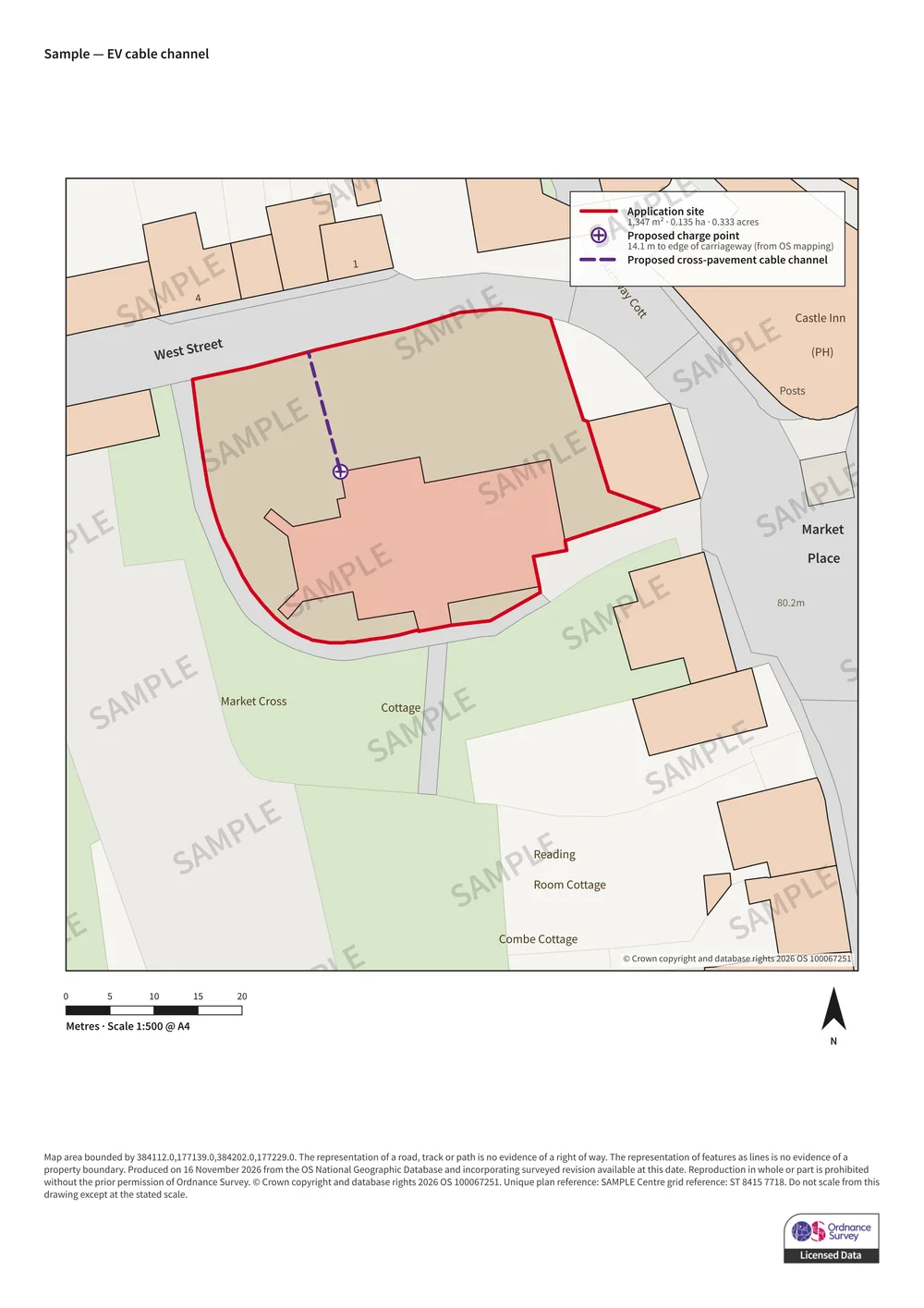
- A block plan at 1:200 or 1:500 showing where the charge point goes and the route of the channel across the pavement to the kerb, with the distance from the wall to the edge of the road.
- Often photographs of the frontage and the charger’s specification — check your council’s list.
Our editor draws both plans from one boundary on current Ordnance Survey mapping. Tap your house to draw the plot, tap the wall for the charger — we measure the distance to the carriageway from the mapping — and tap the route to the kerb. If your council wants the pavement inside the red line too, you can draw it in; you would then also give notice to the highway authority as landowner.
Draw my plansQuestions
Do I need planning permission for a cross-pavement EV charging channel?
In England, from 21 October 2026, usually not: a channel carrying a charging cable from a home to a parked car is permitted development if it is installed by, on behalf of, or with the authorisation of the highway authority. The exceptions are conservation areas, the curtilage of a listed building and scheduled monuments, where planning permission is likely to be needed. You always need the highway authority’s approval for works in the pavement.
I live in a conservation area. Can I still have a pavement channel?
Possibly, but not under the new permitted development rights, which exclude conservation areas. You would apply for planning permission, normally with a location plan and a block plan showing the charger and the channel. Councils differ: some consider these case by case, and at least one county has paused new applications in conservation areas.
Does the charger on my wall need planning permission too?
It can. A wall-mounted charge point is permitted development only within limits: no bigger than 0.2 cubic metres, no higher than 1.6 metres, one outlet per house, not in a conservation area or the curtilage of a listed building, and — on a wall next to the highway — not sticking out more than 0.2 metres or within 1.5 metres of the edge of the carriageway.
What plans does the application need?
Councils set their own lists, but channel suppliers provide a location plan at 1:1250 with a red line round the property, and a block plan at 1:200 or 1:500 showing where the charger and the channel go. Some councils also ask for photographs and the charger’s specification.
Do the new rules apply in Wales and Scotland?
No. The October 2026 changes are to England’s permitted development rules. Wales and Scotland have their own, so ask your council.